
In 1777, everything seemed lost...
... General George Washington, commander of the 13 colonies that revolted against England, was at a great disadvantage. He tried to drive out the British with starving soldiers, without shoes and without weapons. They endured that harsh winter camped at Valley Forge, about 20 miles north of Philadelphia. By spring, a quarter of the soldiers had died from hunger, sunstroke, and illnesses such as smallpox, malaria, and typhoid fever. "I am sure the troops will never be able to do what the people expect and fulfill their duties," wrote Washington in despair in a letter to the state of New Hampshire in 1777, requesting support.
"If we manage to save ourselves, it will be thanks to the Spanish and the French," wrote Alexander Hamilton to the Congress in Philadelphia.
But France had its own problems. Its General, Comte de Rochambeau had no funds to pay his troops stationed on American soil. Only one option remained: to write to the "Key of the New World," the Spanish authorities in Havana. Francisco de Saavedra the commissioner of King Carlos III in Cuba, authorized a loan of 1 million Spanish dollars, or “pesos hispanos”. The money was gathered in 48 hours and sent from the port of Havana on August 17 aboard the frigate Aigrette.
The Spanish Dollar of 1776
The Currency of Independence


Most of the Spanish dollars were minted at the Mexico City Mint, the first mint in all of the Americas, described in 1803 by Alexander von Humboldt s "the largest and richest in the world."Itemployed more than 400 workers, including laborers, engravers, and administrative staff.
The "usually calm Washington" could not hide his great happiness upon seeing the coins, and "was seen by Rochambeau waving his hat towards me in a gesture of great joy," recounted historian Richard M. Ketchum.
Joe Biden: "We would not have been an independent country without you."
In the following years, over 16 million Pesos Hispanos were sent as a "Universal Donation," a collection organized by the Viceroy of New Spain, Martín de Mayorga. Whites, mulattos, Indigenous people, nobles, merchants, and priests all contributed to the first great revolution of the 18th century.
Hispanic support began in early 1775, with the shipment of 300 muskets with bayonets and more than 600 pistols from Bilbao. In 1780, over 11,000 soldiers arrived to fight against the British in Florida, Louisiana, and the Caribbean. Additionally, thousands of Hispanic soldiers and sailors, born in both Europe and the Americas, gave their lives for the new nation. By the end of the war, the countries of the Hispanic Empire had contributed the equivalent of 3 billion dollars in arms, medicines, blankets and uniforms.
Hispanic support for U.S. independence was crucial and continues to be recognized to this day. On December 18, 2014, Barack Obama named Bernardo de Gálvez an honorary citizen of the United States, the highest honor the country bestows on foreigners. He was also recognized on June 28, 2022, when President Joe Biden thanked King Felipe VI during his visit to Spain for the role the Hispanic Empire played in the war against the British. "We would not have been an independent country without you."
The First Global Currency
Extracto del vídeo introductorio del proyecto «Real de a Ocho» de la Ceca Hispana (2022).
The Spanish Dollar not only financed the American Revolution; it was also the currency of the first wave of globalization. For over 300 years, it dominated international trade, becoming the first currency accepted by merchants worldwide—from spice sellers in India to sailors in Cartagena de Indias and cafés in Madrid.
It was minted, among others, with silver from Zacatecas (Mexico) and the mines of Potosí (Bolivia), and traveled across Manila, the Silk Road, China, Europe, and throughout the Americas.
It is estimated that 50% of all the money in circulation in the world during the 18th century were Spanish Dollars.
For over 70 years, it was the official currency in the United States, where it was known as the Spanish dollar or “Peso Hispano”. It was also the official currency in almost all the countries of the Hispanic Empire, including Spain, Mexico, Peru, Bolivia, Argentina, and others, until the 19th century.
Many modern currencies around the world are inspired by the "Peso Hispano”, from the Chinese yuan to the U.S. dollar. A widely held theory attributes the origin of the dollar sign ($) to the bands and columns of Hercules that appear on the shield present on the reverse side of the Spanish Dollar. In particular, those minted from the early 1730s to the late 1770s at the mints in Mexico City, Potosí, Lima, Bogotá, and Santiago de Chile.
Excerpt from the film “España, la primera globalización” by José Luis López-Linares (2021).
These Spanish dollars, also known as "columnarios," were the most widely recognized coins globally, valued for their superior quality compared to older coins, which were hammered into shape.
The columns are surrounded by bands bearing the phrase “PLUS VLTRA,” the official motto of the Hispanic Empire meaning “more beyond,” representing the expansion of its territories into the New World.
A Real Replica
For the first time, you can acquire exact replicas of the Spanish Dollar from 1776.
We have created a limited edition of 1,000 certified silver pieces of the coins that helped George Washington change history.
These replicas have been crafted with respect to the law and the details of the original coin, minted at the Mexico City Mint during the reign of Carlos III, and represent the alliance between the United States and the Hispanic world.
Gift a piece of history, share it, treasure this unique item, beautify your home, or invest in a precious metal like silver.
They honor our legacy, reminding us of what we were and what we can be. They contain a beautiful story—our story.
Let us preserve this legacy for our children, so they understand the significance of the “Peso Hispano” … and the “weight” of the Hispanics in modern history.
Obverse
King of Spain Carlos III in profile, dressed in the style of the emperors of ancient Rome, with a cloak and laurel crown, as a new emperor of America.
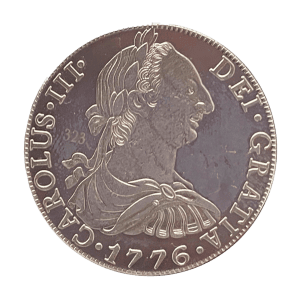
Carlos III era un rey ilustrado, bajo cuyo reinado se recuperó el gusto estético y artístico por el mundo clásico, lo que dio lugar al movimiento artístico «Neoclasicismo» de finales del siglo XVIII.
Inscription
Coat of arms of Spain
HISPAN ET IND · REX · M · 8R · F · M
"King of Spain and the Indies. Minted at the Mint of Mexico 8 reales."





FM: initials of the assayers Francisco Antonio and Manuel de la Peña, who oversaw the coin's issuance in 1776.

Reverse
It represents the coat of arms divided into quarters, featuring the Kingdom of Castile and the Kingdom of León, with the Kingdom of Granada represented by a pomegranate at the bottom.
At the top, the royal crown of the Borbones is illustrated, a house also represented by the fleur-de-lis in the central oval.
La M con una «o» encima es la marca de la ceca de México.
Columnas de Hércules, y sobre ellas, la inscripción «PLUS ULTRA»
Inscription
Coat of arms of Spain
HISPAN ET IND · REX · M · 8R · F · M
"King of Spain and the Indies. Minted at the Mint of Mexico 8 reales."
The Complete Pack
The Complete The pack includes a case containing a numbered replica of the original Spanish Dollar and a stand for display.
It also comes with a booklet summarizing the history behind this 94% silver coin, and a certificate of authenticity.
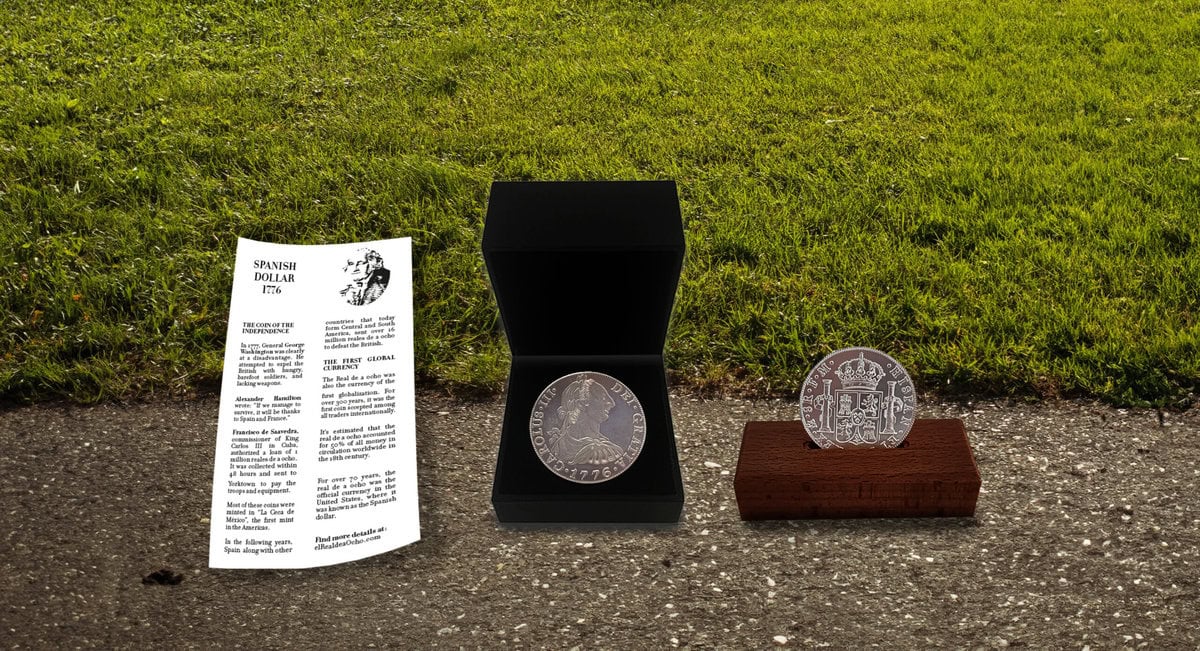
All of this for 199€ plus shipping costs, with delivery available to Spain and the USA for now.
Remember, THERE ARE ONLY 1,000 UNITS, numbered from 000 to 999.
Some media outlets have already talked about us…
Testimonials
"On July 4, 2026, the United States has a great opportunity to commemorate the 250th anniversary of the ongoing contribution of the Hispanic community to the prosperity of its nation. An immense contribution, often overlooked, that began with the donation of millions of Spanish Dollars: the Pesos Hispanos, or Pieces of Eight, which financed much of the U.S. War of Independence."
Guillermo Fesser (writer and journalist)
"The Spanish Dollar was the symbol of our unity when we sailed the sea of History together in a great ocean liner, rather than each of us in a small boat. And it reminds us of what we must become again: One people from the Pyrenees to Acapulco, and from California to Tierra del Fuego."
Marcelo Gullo (writer and professor)
"The motto Plus Ultra, meaning 'further beyond,' coined on the Spanish Dollar, marks the path to the Hispanic world."
José Luis López Linares (film director and producer)
“Cuando me llegó el ‘columnario’ , de la ceca de México, me pasó de la mano al brazo y de ahí a la cabeza, un calambre que me transportó por siglos y miles de millas náuticas a través de la Historia. Tener una réplica de la moneda más importante de la Historia de la Humanidad no tiene precio, porque su valor fue, sin duda, incalculable.”
Javier Santamarta (writer)